
Its sprawling systems keep turning detours into progress, even when rigid missions and an aging PC port push back.
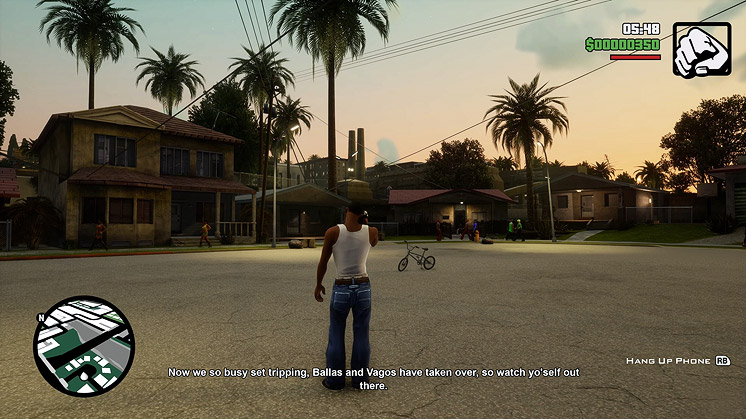
Grand Theft Auto: San Andreas is enormous, but its lasting strength is not the number of roads on the map. It is how often those roads lead into a different kind of game. Los Santos begins as a neighborhood story built around Grove Street, gang territory and family obligations. The countryside strips that familiarity away and turns CJ into a drifter moving between small towns. San Fierro pulls cars, garages and criminal businesses to the foreground. The desert introduces aircraft and military absurdity before Las Venturas escalates into casinos, heists and spectacle.
That constant change gives San Andreas a sense of progression few open worlds manage even now. CJ does not simply unlock more map; he accumulates skills, properties, weapons, relationships and strange competencies until the man who returned home on a bicycle can plausibly infiltrate a secret base with a jetpack. The trade-off is friction. Mission scripting is frequently stricter than the world around it, failure can waste several minutes of travel, and the original PC version carries technical quirks that become more obvious on modern hardware. San Andreas endures because its excess usually compounds into possibility rather than noise.
The State Expands by Changing the Rules
The three cities are memorable because they change the rhythm of ordinary play. Los Santos is comparatively dense and territorial, with familiar streets repeatedly recontextualized by gang warfare and story missions. San Fierro’s hills make even a basic drive more physical, while its garages and street-racing threads push cars closer to the center of the campaign. The rural counties create long stretches of road, dirt tracks and isolated settlements; Bone County then opens the horizon further with airfields and desert military spaces. By the time CJ reaches Las Venturas, casinos, freeways and neon make the same driving-and-shooting foundation feel like a different phase of the adventure.
Mission design uses those shifts aggressively. “Cesar Vialpando” interrupts early gang work with a lowrider rhythm contest. “Black Project” sends CJ into Area 69 for an infiltration that ends with the theft of a jetpack. “Breaking the Bank at Caligula’s” converts a chain of preparations into a multi-stage casino robbery involving disguises, a power cut, explosives and an escape across rooftops. None of these mechanics could carry an entire game on their own. San Andreas uses them as punctuation, which is why a long campaign rarely settles into one predictable cadence.
The same scale can also work against it. A failed countryside objective may mean another long drive before the real challenge, and sparse checkpoints turn repetition into punishment. The world invites improvisation; many missions do not.
Side Activities Are Quietly Some of CJ’s Best Upgrades
San Andreas is often described as an open-world action game with RPG elements, but the important part is how those systems leak into normal play. Weapon skill rises through use. Cycling, driving, motorcycling and flying improve as CJ practices them. Stamina, muscle, fat and lung capacity respond to what he does. Respect determines how many Grove Street members can be recruited. The numbers usually sit behind actions rather than replacing them, so progression feels embedded in the city instead of parked in a menu.
The optional work is more consequential than it first appears. Finishing level 12 of the Paramedic activity raises maximum health; Vigilante increases maximum armor; Firefighter makes CJ fireproof; earning enough through burglary grants infinite sprint. Those rewards can materially change later missions. A player who spends time on what looks like disposable side content can return to the story tougher, faster and less vulnerable to specific hazards without ever touching a conventional skill tree.
Collectibles can have a similar practical value. Completing all Los Santos tags makes an AK-47, Tec-9, sawn-off shotgun and Molotov cocktails appear at the Johnson House, while San Fierro snapshots and Las Venturas horseshoes unlock their own weapon sets at key properties. What looks like map-cleaning therefore becomes a supply network. The benefit is not abstract completion percentage; it is starting future missions with strong equipment already waiting at home.
Progression is not perfectly linear, either. Reaching Hitman skill with the sawn-off shotgun unlocks dual wielding, but the long reload cycle can make that upgrade less convenient when several enemies survive the first blast. Even simple-looking stats can create practical trade-offs.
Mission Variety Is Also the Source of Its Worst Friction
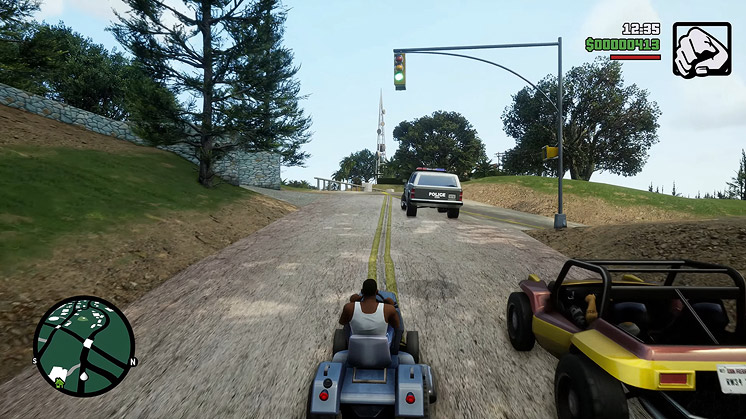
The campaign’s willingness to invent a new rule for one mission is a major reason it remains memorable. Drive-bys, burglary, races, stealth, dancing, remote-control vehicles, casino preparation, aircraft and heavy weapons all appear without turning the game into a formal collection of minigames. The best missions use novelty to reveal another side of the state rather than merely showing off a mechanic.
But San Andreas often mistakes commitment for challenge. Objectives may demand that events happen in a particular order even when the open world suggests another solution should work. Allies can be unreliable, vehicles that must survive can be destroyed by chaos outside the player’s control, and restarting often means repeating setup that has already been mastered. Contemporary open worlds did not yet treat the player’s time as carefully as modern checkpoint systems do, and San Andreas can be especially stubborn about it.
“Learning to Fly” is the sharpest example. Aircraft make sense as the campaign widens, and later missions use them well, but the story requires bronze-or-better results across the flight-school tests before progress continues. A mechanic that might have worked as optional mastery becomes a hard gate. The infamous RC diversions create similar irritation for some players, not because experimentation is unwelcome, but because failure can trap the campaign inside a control scheme or activity it has barely prepared you for.
San Andreas is at its best when variety feels like discovery and at its worst when it becomes an exam. The difference is whether a mechanic expands the sandbox or blocks the story until it is mastered.
CJ Keeps the Sprawl From Becoming a Sketch Show
The campaign could easily have dissolved into a sequence of disconnected parodies. CJ prevents that. He returns to Los Santos after his mother’s death, reconnects with Sweet and the Grove Street Families, and is quickly pulled between family loyalty, old friendships and pressure from the corrupt C.R.A.S.H. unit led by Frank Tenpenny. As the plot sends him hundreds of miles from Grove Street, CJ’s desire to rebuild what he left behind remains a clear emotional reference point.
The supporting cast broadens with the geography. Cesar Vialpando ties family drama to car culture, The Truth ushers the story into rural conspiracy comedy, and Wu Zi Mu brings a calmer criminal partnership to San Fierro and Las Venturas. Big Smoke, Ryder and Sweet keep Los Santos emotionally present even after the campaign moves away. The tonal jumps can be extreme, but the characters stop the state from feeling like three unrelated maps sewn together.
Gang warfare is one of the more interesting attempts to make that relationship mechanical. Territory gives parts of Los Santos a changing ownership layer, while Respect controls how many Grove Street members CJ can recruit. The idea is stronger than the squad AI: recruited gang members can draw fire and contribute damage, but they are not reliable enough to turn the game into a tactical squad shooter. Their value is as another expression of CJ’s growing influence, not a sophisticated command system.
The Original PC Port Rewards Precision but Demands Restraint
The 2005 Windows release is a native PC version, separate from both the PlayStation 2 original and the 2021 Definitive Edition. It brought higher resolutions, longer draw distances, a custom music station and a replay function, and mouse aiming changes the texture of gunfights. Manual targeting makes headshots and precise shots far easier than they were under the console lock-on systems, which can make ordinary shootouts noticeably less threatening.
That advantage comes with peculiarities. The original game’s mouse-sensitivity slider affects horizontal movement rather than both axes, so vertical and horizontal aim can feel mismatched. Contemporary reviews also recorded PC-specific problems ranging from intermittent mouse failure to audio and presentation glitches. These issues are not enough to erase the benefits of mouse control, but they make the port less polished than its cleaner image initially suggests.
Frame rate is the more important modern-PC problem. The original simulation was built around low frame-rate behavior, and running it too fast can alter physics and timing. Higher frame rates have been associated with slower swimming, different vehicle behavior, aiming issues and other gameplay oddities; specialist documentation still recommends limiting the frame rate to avoid a large collection of timing-related bugs. This is more than nostalgia colliding with old graphics. A powerful modern PC can change how the game behaves if the original executable is allowed to run without restraint.
The Definitive Edition has different controls, rendering and technical history. Treating it as interchangeable with the 2005 PC port blurs the strengths and scars of the version being reviewed.
More posts from us you may like:
— PS3 & PS4 Emulator for PC/macOS
— Xbox One & Xbox 360 Emulator
Its Messiness Is Part of the Architecture
San Andreas wants to be a neighborhood crime story, road movie, driving game, shooter, light character-building RPG, gang simulator, casino caper and slapstick sandbox at the same time. It does not fully solve all of those ideas. Companion AI is primitive, some statistics matter far more than others, mission restarts can waste time, and mandatory training occasionally turns breadth into obstruction. The original PC version adds another layer of maintenance because old frame-rate assumptions and input quirks do not disappear just because modern hardware can brute-force the rendering.
Yet the sprawl is unusually purposeful. The state keeps changing context, side activities can feed directly back into CJ’s capabilities, and bizarre one-off missions feel earned because the campaign has spent so long expanding what CJ can plausibly do. Few games make a detour to an ambulance, a wall of graffiti or a shooting range feel like part of the same journey as a casino heist and a military break-in.
Anyone expecting frictionless checkpoints, consistent controls and tightly focused mission design will encounter twenty-year-old edges quickly. But for players who value mechanical variety, a world with strong regional identity and progression that emerges from simply living in it, San Andreas still demonstrates why scale is most effective when it changes what the player can become—not merely how far they can drive.